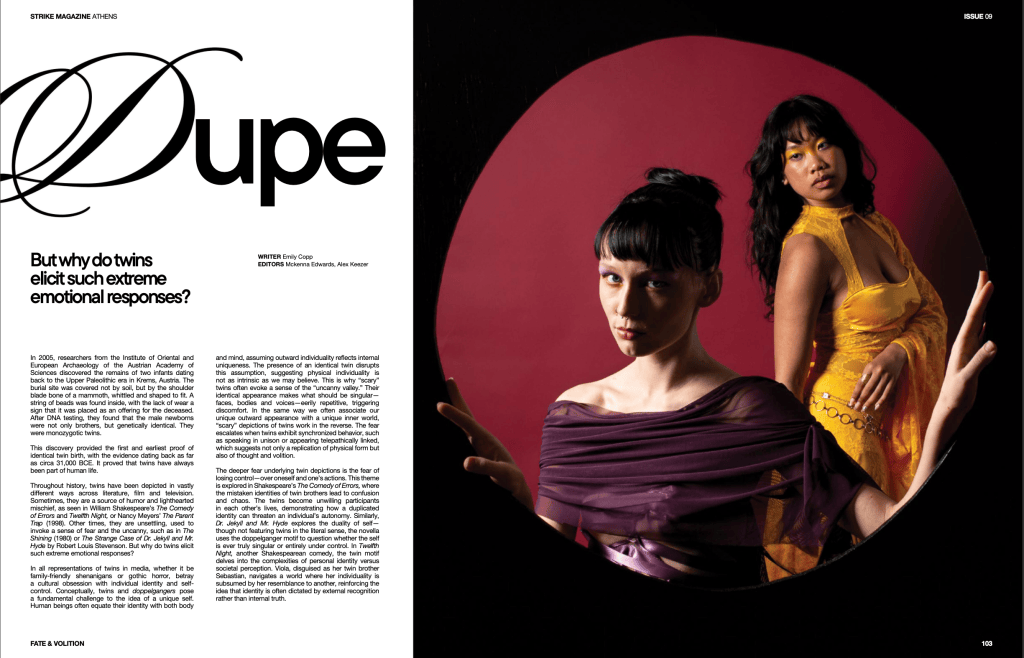
In 2005, researchers from the Institute of Oriental and European Archaeology of the Austrian Academy of Sciences discovered the remains of two infants dating back to the Upper Paleolithic era in Krems, Austria. The burial site was covered not by soil, but by the shoulder blade bone of a mammoth, whittled and shaped to fit. A string of beads was found inside, with the lack of wear a sign that it was placed as an offering for the deceased. After DNA testing, they found that the male newborns were not only brothers, but genetically identical. They were monozygotic twins.
This discovery provided the first and earliest proof of identical twin birth, with the evidence dating back as far as circa 31,000 BCE. It proved that twins have always been part of human life.
Throughout history, twins have been depicted in vastly different ways across literature, film and television. Sometimes, they are a source of humor and lighthearted mischief, as seen in William Shakespeare’s The Comedy of Errors and Twelfth Night, or Nancy Meyers’ The Parent Trap (1998). Other times, they are unsettling, used to invoke a sense of fear and the uncanny, such as in The Shining (1980) or The Strange Case of Dr. Jekyll and Mr. Hyde by Robert Louis Stevenson. But why do twins elicit such extreme emotional responses?
All representations of twins in media, whether it be family-friendly shenanigans or gothic horror, betray a cultural obsession with individual identity and self-control. Conceptually, twins and doppelgangers pose a fundamental challenge to the idea of a unique self. Human beings often equate their identity with both body and mind, assuming outward individuality reflects internal uniqueness. The presence of an identical twin disrupts this assumption, suggesting physical individuality is not as intrinsic as we may believe. This is why “scary” twins often evoke a sense of the “uncanny valley.” Their identical appearance makes what should be singular—faces, bodies and voices—eerily repetitive, triggering discomfort. In the same way we often associate our unique outward appearance with a unique inner world, “scary” depictions of twins work in the reverse. The fear escalates when twins exhibit synchronized behavior, such as speaking in unison or appearing telepathically linked, which suggests not only a replication of physical form but also of thought and volition.
The deeper fear underlying twin depictions is the fear of losing control—over oneself and one’s actions. This theme is explored in Shakespeare’s The Comedy of Errors, where the mistaken identities of twin brothers lead to confusion and chaos. The twins become unwilling participants in each other’s lives, demonstrating how a duplicated identity can threaten an individual’s autonomy. Similarly, Dr. Jekyll and Mr. Hyde explores the duality of self—though not featuring twins in the literal sense, the novella uses the doppelganger motif to question whether the self is ever truly singular or entirely under control. In Twelfth Night, another Shakespearean comedy, the twin motif delves into the complexities of personal identity versus societal perception. Viola, disguised as her twin brother Sebastian, navigates a world where her individuality is subsumed by her resemblance to another, reinforcing the idea that identity is often dictated by external recognition rather than internal truth.
This extends beyond identity crises and into philosophical questions of fate and free will. Throughout history, humans have sought out several methods of understanding and taming that which we cannot control. Before the Enlightenment, human communities relied on tradition and established authority to answer the unknowable. Religious texts served as the primary sources of guidance and truth, and a belief in divinely ordained order gave purpose to all of the world and human history. In Greek and Roman mythology, the deity Poseidon/Neptune is associated with the ocean, earthquakes and wild horses, all representations of unpredictable and unbridled forces of nature. The pantheon of Hellenic deities is often understood in foils, where gods and goddesses are often “paired” in dual roles. Athens’s patroness Athena, goddess of wisdom and strategy, is the feminine foil of Ares, god of war, who represented the distasteful and untame aspects of violence. Practices like witchcraft, prayer, and tarot readings can be seen as attempts to impose structure on the uncontrollable, a way of maintaining agency in an uncertain world. If twin narratives reflect a fear of losing control over one’s own identity, they also mirror a broader existential concern: How much agency do we truly have?
With the emergence of Enlightenment-era philosophy in the 17th and 18th centuries, humanity shifted towards the Modern mindset, wherein empiricism and the scientific method was utilized to explain the unknowable. No longer attributed to divine forces, the limits of autonomy are instead examined through genetics and environment, shifting the conversation from theology to biology. However, there are drawbacks to this method.
Chris Firth’s “The Psychology of Volition” categorizes actions into two diagrams: voluntary acts and reflexes. Movements done by reflex happen entirely outside of human control. For example, we cannot cause our pupils to dilate through thought alone, and we cannot prevent our pupils from dilated when we experience stimuli (light). On the other hand, voluntary acts can both be executed or refrained from with human “will.” But, as Firth points out, there are movements which satisfy both of these definitions. We can choose to blink, but we cannot stop ourselves from the reflex of blinking if we experience a puff of air to the eye.
This blurring of boundaries raises philosophical questions—how much of our behavior is truly within our control? Where do fate and biological determinism intersect? In modern discourse, the fear of fate has been reframed as a debate between nature and nurture.
Because the nature-versus-nurture debate has shaped human thought for centuries, science has sought empirical answers—often at great ethical cost. Pioneered by Francis Galton in the late 19th century, researchers identified twins as ideal subjects for studying genetic versus environmental influences. These studies, continuing throughout the 20th century, provided significant evidence in the quest to understand human genetic influence on behavior. The Minnesota Twin Study (1979–1999), led by Thomas Bouchard, found that genetics play a major role in intelligence, personality, and even political beliefs and religious attitudes. The Swedish Twin Registry has been used to study the heritability of diseases like cancer, cardiovascular conditions, and mental health disorders, confirming that genetic predispositions contribute to these illnesses. The Danish Twin Study explored longevity and found that genetics account for about 25% of lifespan variation. Additionally, research on twins with schizophrenia has shown that if one identical twin develops the disorder, the other twin has a 48% chance of developing it too, demonstrating a strong genetic component. However, the methodologies of such studies often failed to consider the ethical ramifications of experimenting on human lives.
One of the most infamous examples of unethical twin research is the case highlighted in the 2018 documentary Three Identical Strangers. In 1980, 19-year-old strangers Bobby Shafran, Eddy Galland, and David Kellman discovered that they were all adopted from the same agency, they all had the same birthday, and––oh, right––they all looked exactly the same, even down to their uniquely large, baseball-mitt hands. The triplets soon realize that they also have eerily similar personalities–– they all liked Chinese food, smoked the same brand of cigarettes, wrestled in high school, and had the same taste in women. “They were more like clones than brothers,” said Alan Luchs, a friend of David.
The film exposes the Louise Wise adoption agency’s covert experiment in which identical siblings were deliberately separated at birth and studied by psychiatrists Peter B. Neubauer and Viola W. Bernard without the children’s or parents’ knowledge. According to Natasha Josefowitz, a research assistant to Neubaurer, this research aimed to determine whether genetics or environment played a greater role in human development. She recounts the moment that Neubaurer first pitched the idea to her, enticingly stating, “We would put to rest the dilemma of nature or nurture, forever.” Josefowitz claimed that the results of the study showed that our lives were more genetically-driven than we could have ever imagined. “I did not believe it would be as hereditary as it was,” she stated in reference to the findings. “That was more than any of us thought. We are moved to behaviors that we are totally unconscious about.”
But the triplets’ families disagreed. Their birth mother was discovered to have also had extreme mental issues, which manifested in dysfunctional and disturbed teenage years for all three of the boys. However, as they grew older, Eddy’s mental health deteriorated far beyond any of the other brothers’, and he was diagnosed with Bipolar disorder, or Manic Depression. The explanation for this difference was considered to be the difference in the way the boys were raised. The other brothers were able to better cope with their psychological issues because the families who adopted them were open, and talked about their problems. Eddy’s family was quiet. His father was militaristic and strict, and this personality often clashed with Eddy’s artistic leanings, causing their relationship to be poor. On June 16th, 1995, Eddy would tragically take his own life. “Why Eddy? Why Eddy? Why not me?” Bobby asked. “I can’t answer this.” Their similarities––the women, the cigarettes––were superficial. In the ways that mattered, they were completely different. “They were not the case study of biology being destiny,” said David’s older (adopted) sister. “It’s all about nurture.”
The study was never published, and upon his death, Neubaurer sealed it at the Yale University Library until 2066 so that all of the twin participants, born in 1961, would never live to see the results.
In recent years, there has been a drastic uptick in movies concerned with the idea of duplication. From hit TV series Severance to Oscar-winning The Substance to in-theaters Mickey 17, the current world seems to be obsessed with twins and doppelgangers. Critics and influencers argue that this is a reflection of our current socio-political environment, one in which the common man is deeply disconnected from themself. Perhaps it simply reflects the current uncertainty of our world, and the overwhelming feeling of powerlessness that many of us feel.
For as long as humanity has existed, we have grappled with the concepts of fate and volition, assigning them different names and interpretations across time. The cultural obsession with twins is, at its core, a manifestation of this concern—an anxiety over our own autonomy and the forces that shape our identities. Yet, as the history of twin studies has shown, seeking definitive answers to these abstract questions can lead to unintended harm. Should we even attempt to resolve these mysteries, or is the pursuit itself an ethical dilemma? If we ever do find an answer to the debate of fate versus free will, will we regret uncovering it? Perhaps the Postmodern perspective offers the best resolution—there may be no singular answer to the nature of existence. Instead, identity, autonomy, and volition are fluid concepts, shaped by an infinite number of influences both within and beyond our control. Maybe, rather than searching for absolutes, we should embrace multiplicity.
In Song of Myself 51, Walt Whitman writes, “Do I contradict myself? Very well then, I contradict myself. I am large. I contain multitudes.” We all do.

